Choose jewelry that is allergen-free: That’s what matters
Redness on the earlobe, itching under the ring or a burning sensation on the neck after a few hours: If jewelry reacts unpleasantly on the skin, the cause is often not the design, but the material, coatings or moisture between the jewelry and the skin.
If you want to choose jewelry that is allergen-free, you are actually looking for materials that are as skin-friendly and transparently declared as possible. What is important is that no piece of jewelry can be 100 percent allergen-free for every person. Skin reacts individually. However, with the right choice of material, clear product information and a little care, the risk of irritation can be significantly reduced.
What does allergen-free jewelry really mean?
The term allergen-free sounds clear, but is complex in everyday life. An allergy occurs when the immune system reacts to a certain substance. When it comes to jewelry, contact allergies are particularly common, i.e. reactions to the area where the jewelry is placed.
The best known is nickel. Nickel can occur in alloys, clasps, studs or under a plating. In the EU there are therefore limit values for the release of nickel by objects that are in direct contact with the skin for a long time. A very low release limit applies to jewelry that comes into direct and prolonged contact with the skin. The requirements are even stricter for piercing plugs.
Nevertheless, legal limits reduce the risk, but do not replace personal tolerance. Particularly sensitive skin can also react to small amounts, friction, sweat, cosmetic residues or other metal components. That's why it makes more sense to look for skin-friendly jewelry with clear material information instead of relying solely on marketing terms.
The most common triggers for jewelry
Not every redness is automatically an allergy. Sometimes it is irritation from friction, moisture or care products. Several factors come together, especially when it comes to rings, tight bracelets and earrings: skin, metal, sweat, soap and exercise.
| Possible trigger | Where he often occurs | What you should pay attention to |
|---|---|---|
| Nickel | Alloys, stud earrings, clasps, cheap fashion jewelry base metals | Clear material information, serious workmanship, be particularly careful if you have a known nickel allergy |
| cobalt or chromium | Some metal alloys | If reactions recur, have them checked dermatologically |
| Worn coatings | Gold or silver plated jewelry | Check what base material is underneath and whether the coating is durable |
| Moisture and soap residue | Rings, bracelets, tight necklaces | Dry jewelry regularly and keep skin clean under jewelry |
| Cosmetics and perfume | Necklaces, earrings, bracelets | Put jewelry on last and reduce contact with sprays, creams and cleaners |
Particularly tricky are pieces of jewelry that are initially well tolerated but later cause problems. This often happens when a coating becomes thinner and the underlying metal comes into greater contact with the skin.
Materials in comparison: Which ones are more skin-friendly?
The choice of material is the most important step if you want to choose jewelry that is allergen-free or at least as irritating as possible. It's not just about the metal name, but also about the alloy, surface, processing and intended use.
| material | Skin tolerance in everyday life | advantage | Important note |
|---|---|---|---|
| Stainless steel | Well suited for many people | Robust, easy to care for, water-resistant | Depending on the alloy, it may contain nickel; the nickel release is crucial |
| Titanium | Very skin-friendly | Lightweight, corrosion resistant, popular for piercings | Looks often more technical and less classic |
| Niobium | Very skin-friendly | Good option for sensitive ears | Less common in costume jewelry |
| 925 silver | Often well tolerated | Classic, high quality, versatile | May tarnish and should be clearly marked as sterling silver |
| Gold | Depending on the alloy, well tolerated | Noble, durable, timeless | White gold may contain nickel, depending on the alloy |
| Gold or silver plated jewelry | Strongly dependent on the base material | Nice look at a moderate price | Coating may rub off over time |
Stainless steel: practical, modern and suitable for everyday use
Stainless steel is popular in everyday life because it is robust, water-resistant and easy to clean. It is a good choice for many people, especially if they want to wear jewelry every day and prefer a modern, minimalist design. If you want to find out more about the benefits of this material, check out the LUMOIR Guide Stainless steel jewelry additional background information on durability, care and style effect.
But it is important to be honest: stainless steel is not automatically completely nickel-free. Some stainless steel alloys contain nickel that is bonded into the material. What matters is how much nickel is actually released into the skin. Anyone who has a strong nickel allergy should therefore pay particular attention to product information or, if in doubt, ask.
Titanium and niobium: particularly interesting for sensitive ears
Titanium and niobium are considered particularly skin-friendly materials and are often recommended for piercings or very sensitive ear piercings. They are corrosion-resistant and generally release few problematic substances into the skin. However, they are not always as common for minimalist jewelry looks as stainless steel, silver or gold.
Silver, gold and white gold: check alloy
Sterling silver consists of 92.5 percent silver, the rest is mostly copper. It is wearable for many people, but can tarnish and requires some care. You should be careful with very cheap or unclearly declared silver-colored jewelry, as these are not automatically real silver.
Gold is not always the same as gold. Pure gold is very soft, which is why jewelry gold is alloyed. The lower the gold content, the greater the proportion of other metals. When it comes to white gold, the alloy is particularly important because older or cheaper versions may contain nickel. Rhodium plating can protect the surface but will wear away over time.
Nickel-free, hypoallergenic, allergen-free: read terms correctly
Many product pages use terms such as nickel-free, hypoallergenic or allergen-free. They sound similar, but don't always mean the same thing.
Nickel-free can mean that no nickel was intentionally used. But it can also mean that the nickel release is below a certain limit. Hypoallergenic literally means that a product is less likely to cause allergic reactions. But it's not a promise that no one will respond.
Allergen-free is particularly important when it comes to jewelry. Since allergies are individual, the term should be understood as a reference to the selection of materials that reduce irritation. More reliable than a single keyword are specific information such as stainless steel, titanium, 925 silver, gold alloy, coating and care instructions.
Choose allergen-free jewelry depending on the type of jewelry
Earrings are the most critical category for many. Ear piercings are more sensitive than normal skin areas, especially if they are recently pierced, irritated or have not healed completely. If you have sensitive ears, you should pay particular attention to plugs, hoop pins and clasps, as these are the parts that have direct and long-term contact with the skin.
Rings can also cause irritation, even if the material is generally well tolerated. Water, soap residue or hand cream quickly collect under a ring. If the ring is very tight, additional friction occurs. That's why everyday rings should fit comfortably and be dried briefly after washing your hands.
Necklaces often react with sweat, perfume, sunscreen and hair products. If you get redness on your neck easily, choose smooth, well-made chains without rough edges. A pendant should not be too heavy so that it does not constantly rub against the same area of skin.
Bracelets and bangles are usually less problematic than earrings, but they can cause irritation from movement, sweat, and a tight fit. A slightly loose fit is often more comfortable than a very tight piece of jewelry. For personalized bracelets or necklaces, it is also important that the engraving areas, settings or birthstones are cleanly processed and have no sharp edges.

Skin compatibility in everyday life: It's not just the material that counts
Even well-tolerated jewelry can become uncomfortable if it remains permanently moist or comes into contact with irritating substances. Especially in summer, when doing sports or after showering, many people react more sensitively because sweat and heat put a strain on the skin barrier.
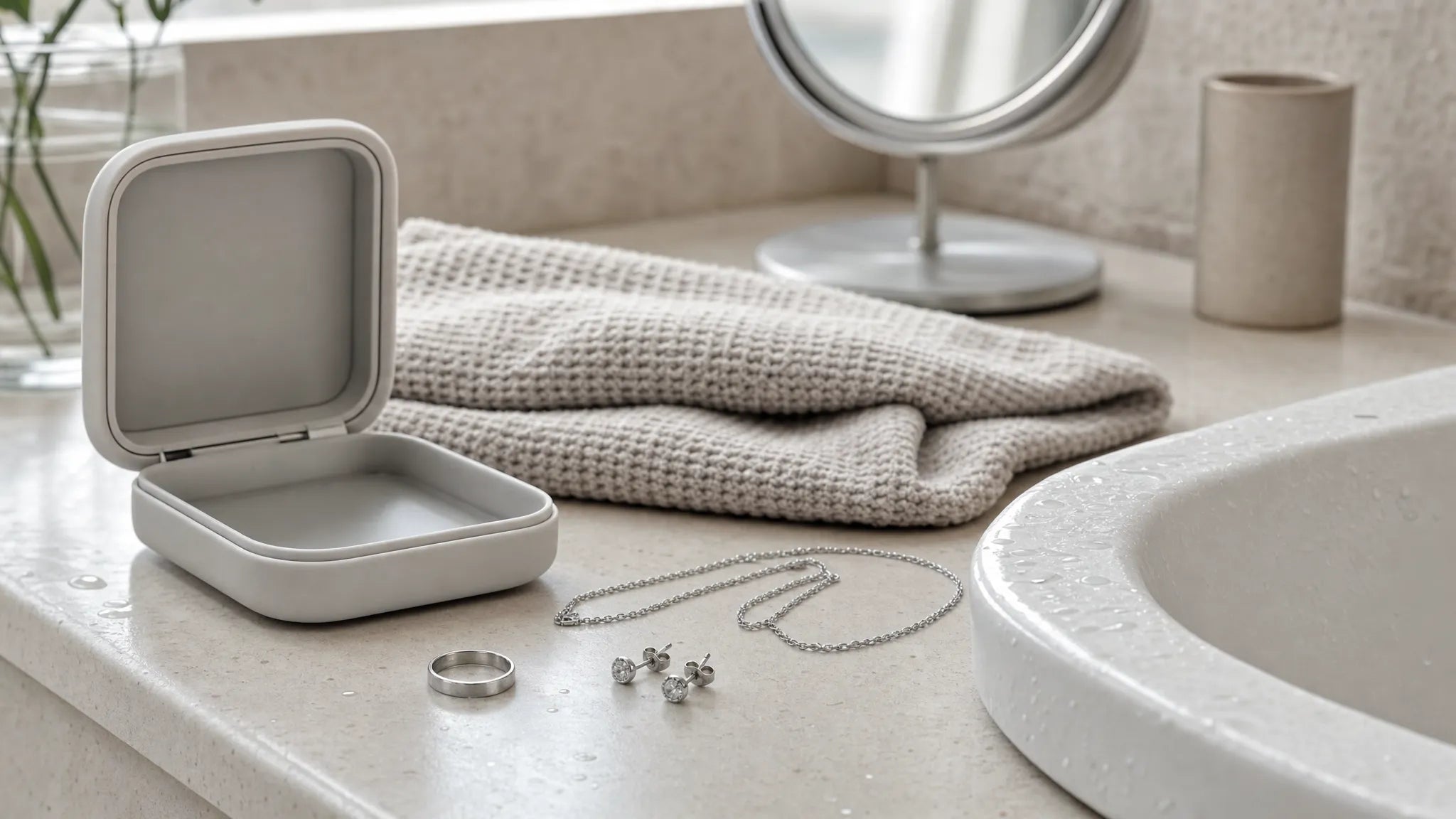
Water-resistant jewelry is practical because it is less sensitive to moisture in everyday life. Still, water-resistant doesn't mean that the skin underneath will never be irritated. Soap, chlorine, salt water and cosmetics can remain on the skin and become trapped under rings or bracelets. You can find out more about this in the LUMOIR guide waterproof jewelry.
A simple routine helps: put jewelry on last so that the perfume, hairspray and cream have already been absorbed. After exercising or swimming, gently dry your jewelry and skin. If an area is irritated, pause the jewelry until the skin calms down.
Buy online: You should clarify these questions before checkout
When buying online, you can't see a piece of jewelry directly on your skin. Clear information is all the more important. Reputable providers explain what material a piece of jewelry is made of, whether it is coated, how it should be cared for and what return conditions apply.
Transparency is not only important for jewelry. In other areas too, customers are more likely to trust providers who clearly show services, reviews and contact channels, for example with one Jointing company in København and Nordsjælland. The same principle applies to jewelry: the more precise the information, the easier it is for you to assess whether a piece suits your skin and your everyday life.
Before you buy, it's worth doing a quick check:
- Is the main material clearly stated, for example stainless steel, 925 silver, titanium or gold?
- Does it explain whether the piece of jewelry is gold-plated, silver-plated or otherwise coated?
- Are clasps, ear studs and contact surfaces also made to a high quality?
- Are there care instructions for water, sweat, cosmetics and storage?
- Are shipping, returns and payment methods described transparently?
- If you are unsure, can you contact customer service?
If you order jewelry online in Switzerland, it also helps to have clear information about shipping costs, return policy and payment security. LUMOIR Jewelry offers, among other things, secure payment transactions, 14 day returns, 24/7 customer support and free shipping from 50 CHF. You can find further general information in the guide on the topic Buy jewelry online safely in Switzerland.
What to do if your skin reacts to jewelry?
If a piece of jewelry causes itching, burning, redness, swelling, or small blisters, you should first remove it. Gently clean the affected area with water and avoid further irritation from perfume, aggressive soaps or friction. Don't wear the piece of jewelry straight away just because the reaction wears off.
If the symptoms recur or are severe, a dermatological examination is advisable. A dermatologist can check whether there is a contact allergy, for example through a patch test. This is especially helpful if you don't know whether nickel, cobalt, chromium, fragrance, or another allergen is the trigger.
It is also important not to condemn individual pieces of jewelry across the board. Sometimes the skin reacts not to the visible material, but to a clasp, a coating, residue from cleaning products or moisture underneath the jewelry.
Frequently asked questions about allergen-free jewelry
Is stainless steel jewelry allergen-free? Stainless steel is well tolerated by many people, but is not automatically allergen-free for everyone. Some alloys may contain nickel. Quality, workmanship and nickel release are crucial. If you have a strong nickel allergy, you should check material information particularly carefully.
Which jewelry is best if you have a nickel allergy? Titanium, niobium or clearly declared nickel-free materials are often recommended. High-quality stainless steel can also work for many, but should be checked individually if you have a severe nickel allergy. If you are unsure, dermatological advice can help.
Why do earrings itch even though they are described as nickel-free? Possible reasons include friction, moisture, cosmetic residue, another metal component or a worn coating. Sensitive or not completely healed ear piercings also react more quickly.
Can real gold jewelry cause allergies? Pure gold is considered to be very inert, but jewelry gold is made of alloys. Depending on the gold content and additional metals, reactions can occur. When it comes to white gold, you should pay particular attention to the alloy.
How do I test whether I tolerate a piece of jewelry? First wear new jewelry for a short time on clean, dry skin. Observe the area afterwards. If you have known allergies or have had severe previous reactions, you should not experiment, but rather look for suitable materials.
Choose consciously, wear more beautifully
Choosing jewelry that is allergen-free means, above all, paying conscious attention to the material, workmanship and suitability for everyday use. Clear information, smooth surfaces, appropriate sizes and a simple care routine are often more important than big promises.
If you're looking for minimalist, timeless jewelry designed for everyday wear, look no further LUMOIR Jewelry elegant stainless steel designs for women and men, inspired by light and French aesthetics. Check the material specifications, choose pieces that suit your skin and style, and if you have sensitive skin, start with a single favorite rather than too many new pieces of jewelry at once.

From Yannick Aebischer